The 39 Trillion Trap and What It Quietly Does to Your Retirement
The $39 Trillion Trap (And What It Quietly Does to Your Retirement)
Nobody told you the rules changed.
When you started saving in your 30s, the deal was simple. Work hard. Put money in the 401(k). Own a house. Stay the course. Retire at 65 with enough to live on.
Nobody sent a letter when that math stopped working. No advisor called. No bank flagged it. The brochure never got updated. You just kept following the plan, doing your part, trusting the system, while behind the scenes, the country quietly ran up a bill that guarantees your dollars will be worth less every year you hold them.
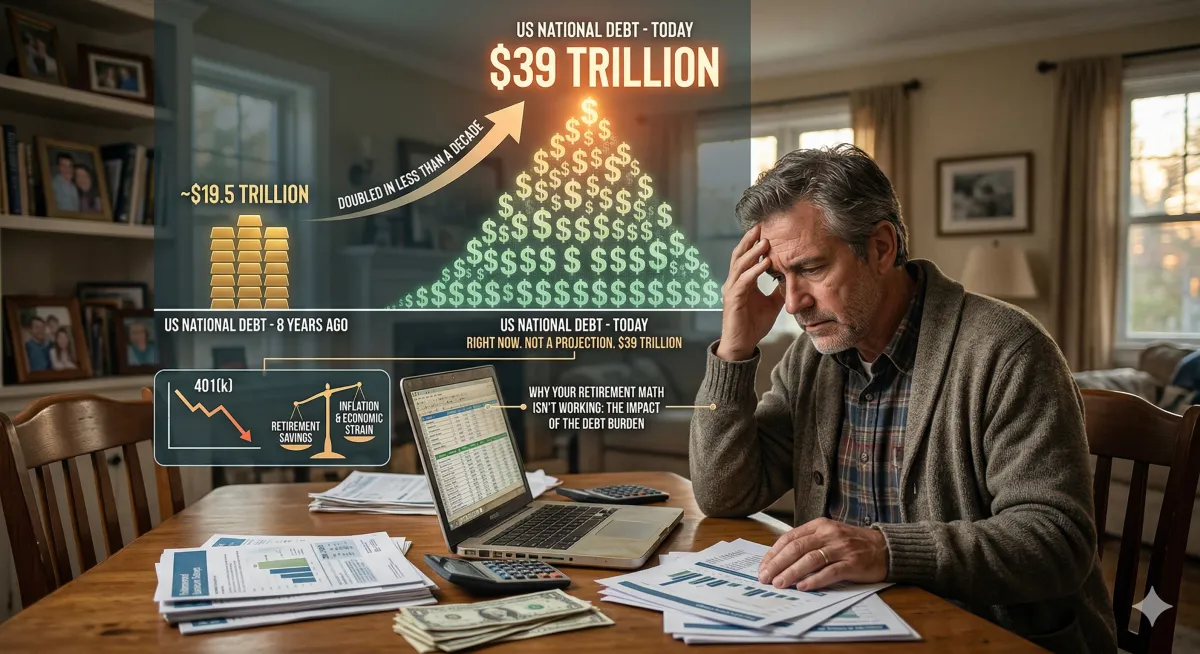
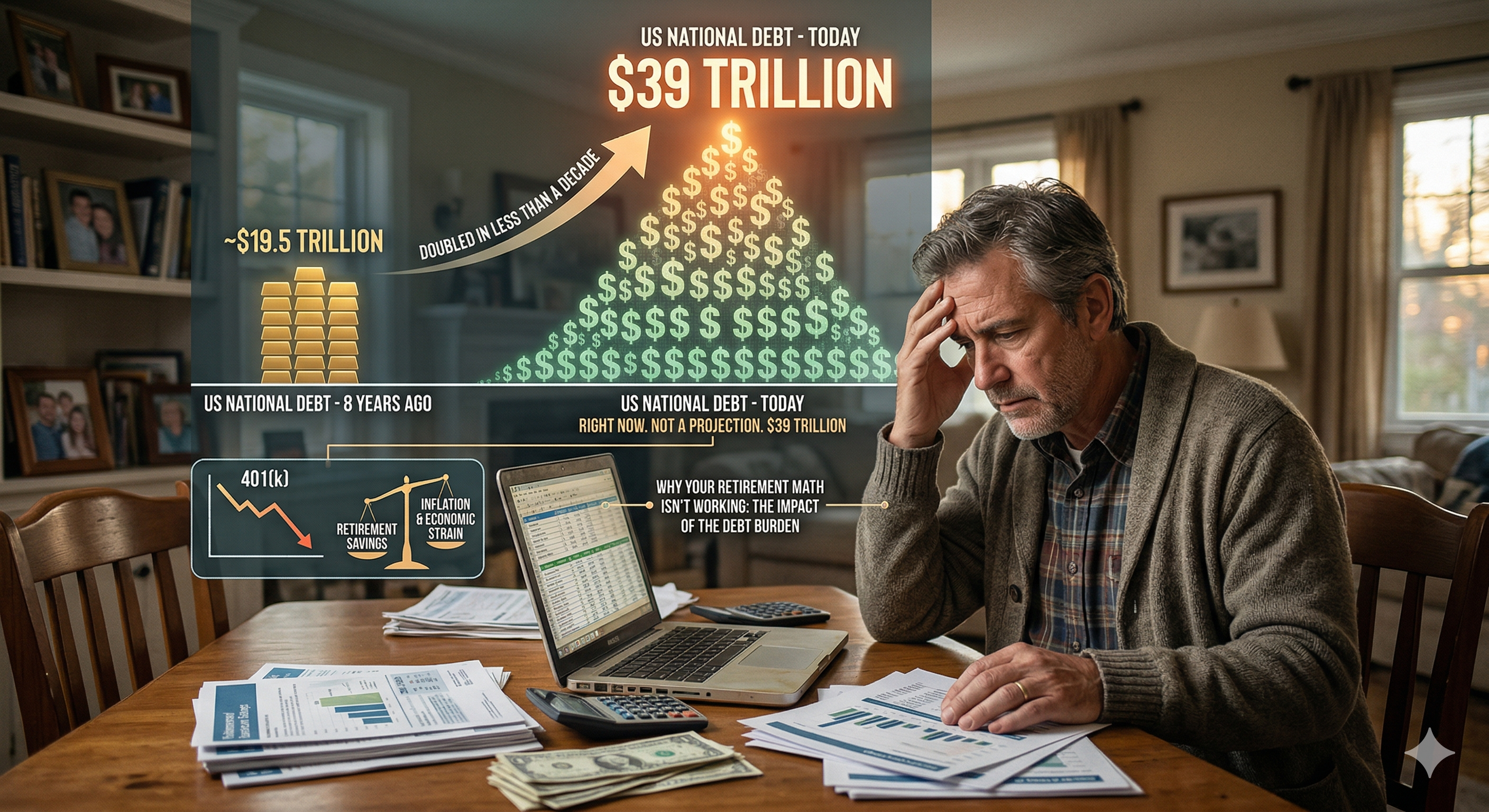
That bill now sits at $39 trillion. That's what the United States now owes. Not in some distant projection. Not in a worst-case scenario. Right now, today, the federal government is carrying $39 trillion in national debt. Eight years ago, that number was about half what it is today. We doubled the entire national debt of the United States in less than a decade.
If you're 50 and trying to figure out why your retirement math isn't working, that's the number that explains a lot. Your advisor won't bring it up. The financial planning software won't model it. But it sits underneath every dollar you've saved, quietly deciding what those dollars will actually be worth when you go to spend them.
I spent years following the standard financial playbook and then looked up one day and realized the playbook was written for a country that no longer exists. So let me walk you through what's actually happening, in plain English, with real numbers.
The Number That Tells the Whole Story
The other important number is the federal debt that the Congressional Budget Office says is running at about 101% of GDP this year, and it's projected to climb to 120% by 2036. That's not a fringe analyst with a doom newsletter. That's the government's own forecasting office. When federal debt hits 101% of GDP, it means the U.S. government owes more than the entire country produces in a year. For every dollar of economic output, there's $1.01 of federal debt outstanding. And nothing on the political horizon suggests that trend is going to reverse, because cutting spending costs elections and raising taxes costs elections, and the one thing both parties have in common is that they intend to keep getting elected.
![[Screenshot 2026-04-09 at 3.34.17 PM.png]]
So the path is the path. By the time the current administration leaves office in January 2029, the debt will likely be sitting somewhere between $46 trillion and $50 trillion. Nothing cataclysmic has to happen for that to be true. No new war. No new pandemic. No new bailout. That is simply the math of where we already are, extended forward in a straight line.
What This Really Does to Your Money
Here's the part the official story leaves out.
When the deficits are this large and the interest bill is this heavy, the system develops a quiet preference for letting the dollar lose value over time. It's the only way the math works. If your dollars are slowly worth less every year, the existing debt becomes easier to carry, which means politicians can keep spending and the central bank can keep printing money out of thin air to keep the machine going. Everybody at the top gets what they need.
![[Screenshot 2026-04-09 at 3.42.27 PM.png]]
The cost of that arrangement gets paid by anyone who stores their wealth in dollars and dollar-denominated assets.
This isn't theory. Look at the data since 2019. Over the last six years, the gross federal debt index is up 65.7%. The total US money stock is up 45.9%. Real weekly earnings, the actual purchasing power of your paycheck, are up just 3.9%. You worked hard. You saved. You did the things you were told to do. And the value of what you saved was being quietly diluted by a system you never voted for.
![[Screenshot 2026-04-09 at 3.44.52 PM.png]]
Even the official inflation numbers, which understate reality for most of us, tell the story. The Fed's preferred core PCE measure is sitting at 3.1%. CPI is at 2.4%. The Fed itself is holding rates between 3.5% and 3.75% because they know the inflation fight isn't actually finished. And on top of that, fresh oil shocks tied to tensions in the Strait of Hormuz, which carries about 20% of global petroleum supply, are reheating the very thing the Fed claims to be containing.
So here's what your "safe" retirement plan is actually up against: a fiscal machine that needs the dollar to lose purchasing power, an inflation problem that hasn't gone away, and a Fed that no longer has the freedom to do anything meaningful about it.
Why Traditional Advice Stopped Working
The retirement playbook you were handed assumed a world where inflation was 2%, debt was manageable, and the dollar was a safe place to store decades of work. Save 10% of your income. Put it in index funds and bonds. Retire at 65. Live on 4% withdrawals.
That advice wasn't malicious. It was just built for a different country.
The country we actually live in has a $39 trillion debt load that's compounding faster than the economy can grow. It has interest payments competing with every other priority in the federal budget. It has a Fed that's politically and financially trapped. And it has a measurement problem where official inflation numbers consistently understate what you experience at the grocery store, the doctor's office, and the insurance renewal.
Inside that environment, the old advice doesn't just underperform. It mathematically can't work. If your portfolio is returning 6% to 7% after fees, and the actual erosion of your purchasing power is running closer to that, you're not building wealth. You're running on a treadmill that's tilted slightly downhill.
This is the part nobody tells you when you're 35. By the time you're 55 and you can finally see it clearly, you feel like you must have done something wrong. You didn't. The rules changed and nobody updated the brochure.
The Real Risk Is the One You Can't See
The conversation about "risk" in personal finance is upside down. You've been trained to think of volatility as the danger. The S&P dropping 20% is scary. A 50% drawdown in something is terrifying. So you're told to stay in "safe" assets. Cash. Bonds. Conservative allocations.
But there's a different kind of risk that doesn't show up on a chart. It's the risk that the measuring stick itself shrinks. The risk that you get to retirement on schedule, with the number you were told to hit, only to find out that number doesn't buy what it used to. That's the risk the $39 trillion debt load is quietly creating for everyone who plays it "safe."
This erosion in purchasing power that you don't really see is what's gutting most retirement plans right now.
The honest question for anyone in their 40s, 50s, or 60s isn't "how do I avoid risk?" It's "which risk do I want, and which one am I prepared to manage?" Because doing nothing is a choice. And in this environment, it's a remarkably expensive one.
Where the Math Actually Points
If the system needs the dollar to slowly lose value to survive, then storing your future in dollars is the one thing the math says you can't afford to do indefinitely. Some of your wealth has to live somewhere the politicians can't quietly tax through the back door.
That's why a growing list of institutions, including BlackRock, Fidelity, and yes, Vanguard, the company that spent decades telling you to buy index funds, are now offering exposure to assets like Bitcoin with a fixed supply. Because nobody, not Congress, not the Fed, not the Treasury, gets to issue more Bitcoin with a press release. The supply is the supply. It's 21 million and that's it.
This is not a pitch to bet the farm. It's a reframe of what "conservative" actually means in a country with $39 trillion in debt and an interest bill that's about to double. Conservative used to mean cash and bonds. In this environment, conservative might mean owning at least some of your future in something like Bitcoin, where the political system can't dilute it.
You don't have to figure that out today. You just have to stop pretending the old definition still applies.
The Bottom Line
The United States is carrying $39 trillion in debt. The deficit nearly tripled in eight years. The interest bill alone is approaching a trillion dollars a year and is on track to double in the next decade. The Fed is trapped between fighting inflation and protecting the federal budget, and savers are the ones absorbing the cost.
This is not a forecast. It's a description of where we already are.
If you're behind on retirement and stuck in the standard playbook, you're not behind because you made bad decisions. You're behind because the rules changed and the people writing the rules have no incentive to send you the memo. The math on traditional savings vehicles assumed a stable currency and disciplined spending. We have neither.
The first move isn't to panic. It's to see clearly. Once you understand what the $39 trillion number is actually doing to the value of every dollar you've saved, the conversation about where to put your money next finally starts making sense.
You weren't given the full picture. Now you have it.
If this hit something for you, subscribe and pass it along to someone in their 50s who's quietly worried about their retirement number. The math is brutal, but the path forward is clearer than you think. We'll keep walking it together.
J. Scott
This article is for educational purposes only and does not constitute financial advice. Always do your own research before making investment decisions.
